
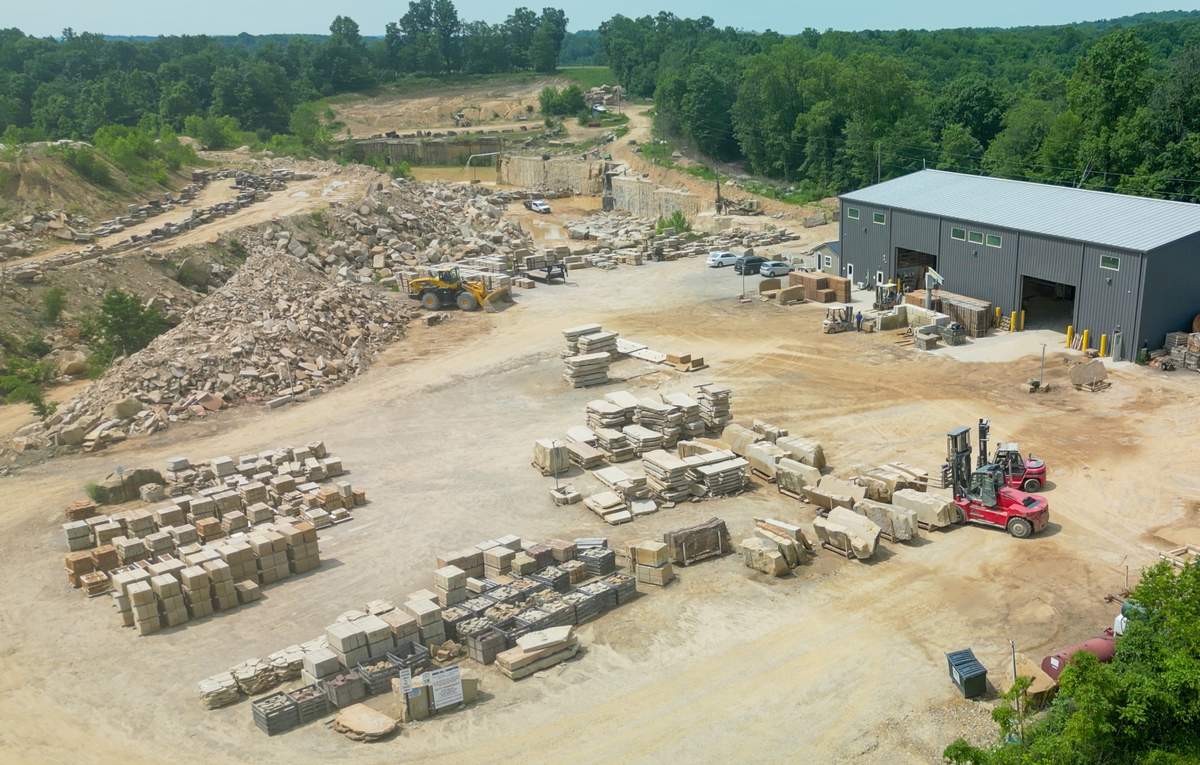
The year was 1917. Robert Blum, a sandstone guru and stone-cutter by trade, was searching Holmes County, Ohio, for unique stone quarries. The Blum family lived near Cleveland and had experience with sandstone. They recognized the industry’s potential and were searching for a specific color of stone.
Blum lucked out near Glenmont, Ohio, where he found an abundance of high-quality sandstone with the ideal cream color he was seeking. After Blum and his family began piecing together a plan to open a quarry and harvest the sandstone, they needed a name. They remembered the time a New York salesman, who was in the area to inspect the quarries, commented that the hills were covered with briars. And so “Briar Hill” Stone Company was born.
To harvest the sandstone, the company used dynamite to blow up sections of the base layers, then lifted out the rock with large, stationary cranes. A tall mast with a boom extending over the quarry used cables and pulleys to lift stones weighing 5–15 tons onto wagons, rail cars, or trucks. These stones were then transported to the mill, where they were cut into finished pieces.
Prior to the 1900s, building foundations were mostly made of natural sandstone. As poured concrete and concrete blocks became available, the demand for sandstone foundations decreased. Briar Hill found its niche, however, by landing contracts to provide stone for colleges, government buildings, large homes, and many other applications. One of their first significant projects was providing stone for the exterior of Yale University.
While poured blocks and concrete were convenient, there was still a class of people who preferred the look of sandstone. Briar Hill quickly developed a solid reputation for their quality stone and good work ethic. During their prime, they employed more than 300 people, and one report classed them as Holmes County’s best place of employment.
Throughout the years, Briar Hill had many fine employees, but one man stood out among the rest. His name was Bob Akins. Bob began working for Briar Hill Stone Company in 1947. He was employed by the company for 75 years, until he passed away in 2023. Even in his last days at Briar Hill, this diligent ninety-year-old was the one to unlock the doors and open the gate at 6 am. The commitment and dedication of Bob Akins was outstanding and a blessing to all who knew him.
But as the 1900s expired, so did the glory days of the old Briar Hill Stone Company. The last ownership change had been in 1992, when Briar Hill was purchased by three partners from southern Ohio. They owned another stone quarry and were looking to expand their operation. These partners saw Briar Hill as an avenue to fund their luxurious lifestyles. They were fine with drawing funds from the company but were not willing to invest in it to keep everything running smoothly and up to date.
By 2020, two of the partners had passed away, leaving only Frank. This remaining owner was 82 years old, very frugal, and an expert micromanager. However, some of the stone-cutting equipment in use was still from the early 1900s, and inefficiencies were everywhere. Orders were going unfulfilled. Bills were going unpaid. Liens were placed against the company.
Slowly, Briar Hill’s customers started looking elsewhere for sandstone products. Despite owning numerous stone quarries with an unmatched array of color and texture options, the business was headed for bankruptcy.
Out of the Ashes
Since the early 2000s, Oak Leaf Landscaping, a local company owned and operated by Tobias Yoder, frequently used Briar Hill sandstone on projects. This was his preferred stone. It was durable, had a nice color, and best of all, it could be purchased locally. For years, Tobias saw the decline of Briar Hill and heard rumors that it would be sold. However, he had no clue about all the complications potential buyers faced.
In the summer of 2021, Tobias and one of his employees were at Briar Hill, looking for some sandstone. Seeing the facility’s run-down condition, the lack of production, and the poor employee morale left him disheartened. He was sad to see a company with such a rich history, natural resources, and potential going to waste.
An idea began to form in Tobias’s mind. He asked one of the salespeople if they were still planning to sell Briar Hill. The salesperson said that the last potential sale had just fallen through again. Tobias asked for the owner’s name and phone number, thinking there must be some way to keep the business in operation.
During the short phone conversation, Frank asked Tobias to write a letter explaining who he was and what his plan was for the business. Tobias agreed and sent the letter in the mail. After a month without a reply, he called Frank a second time. Frank said he had received the letter and would consider selling the business but was still working on the numbers. So, the wait continued.
A few months later, the phone rang. It was Frank. He said he would like to meet as soon as possible.
On New Year’s Day of 2022, Tobias and Kevin, a manager at Oak Leaf, met with Frank, unsure of what they would hear. Cordially, but with a hidden sense of urgency, Frank gave them a price for the assets and real estate. He went over the details of what would be included in the transaction. There was the mill on 75 acres, four quarries on an additional 275 acres, life leases on four more quarries, and lots of equipment.
The following months were a journey of discovery. With the assistance of an attorney named Garret Roach, Tobias and Kevin learned that numerous liens were held against the old mill in Holmes County. Roach was very familiar with the business, especially since his father had lost a few fingers at Briar Hill in its early days. Meanwhile, the mill and 275 acres of stone quarries were on the fast lane to foreclosure.
After countless hours of thought, prayer, and meetings with the leadership team at Oak Leaf, Tobias concluded that it was more than they wanted to pursue on their own. He contacted a business acquaintance, James Schlabach, to see if he would be interested. He was. After multiple meetings and visits to the quarries, Tobias and James decided to take on the challenge together. And so they began a relationship of trust and faith, not knowing what they would all face.
Through a roller coaster of events over the next few years, James brought a positive dynamic to the partnership. Tobias was grateful for his partner’s courage and organizational skills. Finally, they struck a deal with Frank to make the purchase in two phases. In June 2022, phase one was the purchase of all the quarries and leases, and phase two would be the purchase of the mill.
Soon after the purchase of the quarries, Tobias got a call from a building contractor inquiring about buying sandstone for a large new construction project at Kenyon College. Frank was still operating the old mill, but without access to the quarries, he could not fill the order. Because of the liens on the mill property, there was no way of knowing when the mill could be purchased or whether it would be shut down by the lien holders. That meant that to accept the stone order, a new building would need to be built at a new location with new equipment and an entirely new set of employees.
New Beginnings with a Rich History
Tobias found several men and boys who were interested in diving headfirst into the new industry. The plan worked, but not without some hurdles. The biggest challenge was the lack of knowledge, since no one had any experience. Tobias recognizes the sweat and challenges the first three employees, Ivan, Aaron, and Phil, faced. All three received invaluable training from existing employees at the old mill while they constructed a new mill several miles away, but some things would just have to be learned the hard way.
Combined with the men’s inexperience and the realities of COVID, each day brought its challenges. New equipment for the mill was bought from China, but the software was faulty, and it was hard to get good customer support. With assistance from Keim Electric, the software was Americanized and configured to run efficiently.
Throughout this time, the old mill continued to face legal challenges. Even after the new Briar Hill Sandstone began, the old mill continued to operate under the old ownership, cutting up previously mined stone until the day the power company showed up to shut off the electricity due to unpaid bills.
The first stone at the new mill was cut in the spring of 2023. It was a monumental achievement for everyone involved. Every day brought new milestones and a steep learning curve, but things were headed in the right direction.
Russ, the foreman of more than 40 years from the old mill, showed up at the new Briar Hill one day, looking for work. He had a pair of gloves and his lunchbox with him. Tobias’s team took care of the paperwork and put him to work right away. Russ had extensive experience and was a certified blaster through the Ohio Department of Natural Resources. This was a big step in the right direction for the fledgling mill.
Becoming a certified blaster requires a special license, and the applicant needs to work for two years under someone who already holds a blaster’s license. Phil Miller, the next prospect to get a license, was assigned to lead the quarry team and gained a lot of knowledge and wisdom by working alongside Russ.
Briar Hill hired two more men, Steven Miller and Alan Mast, to help manage the mill in the coming year. Alongside Phil, the average age of the trio of leaders was only 28. Part of what has made the entire venture special to Tobias and James is seeing the young men develop and lead a company they had zero knowledge of just a few years ago.
A Day at Briar Hill
Today, the crew at Briar Hill consists of 13 men, including a few in their senior years. Their time cards hit the clocks at 6:30 every weekday morning, but work doesn’t begin until 6:45. Instead of taking a 15-minute afternoon break, the team prefers to take one in the morning when they arrive. Chatting about life and the latest news while sipping coffee has become the preferred way to start each day.
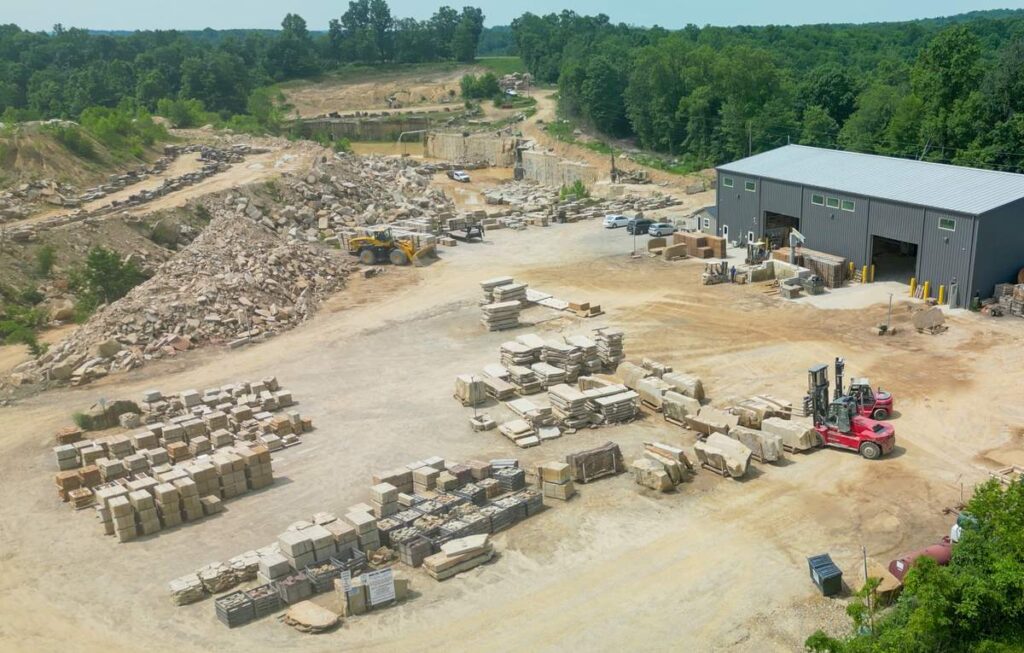
Additionally, every Monday morning, the coffee time extends beyond the standard 15 minutes to allow time for an inspirational talk and some general safety reminders. Then the group splits into two teams: the quarriers who harvest the stone and the shop team who cut and shape it.
The quarry team consists of four men. Their main stone quarry is on the same property as the mill, but Briar Hill owns an additional four quarries in surrounding counties and leases a few more. Depending on the orders, the quarriers travel to their other quarries to harvest unique shades and colors.
When touring a stone quarry, visitors are often fascinated by the explosives and heavy equipment needed to harvest the stone. On a typical day, Briar Hill makes around six blasts with explosives to remove large chunks of stone. To do so, they drill 2.5-inch holes around the perimeter of the area they want to blast and then load the holes with the correct amount of explosives. Next, they vacate the area until after the blast. Once blasted, the stones are pried away with a large excavator and transported to the mill with a giant loader. An average stone weighs around 10-12 tons.
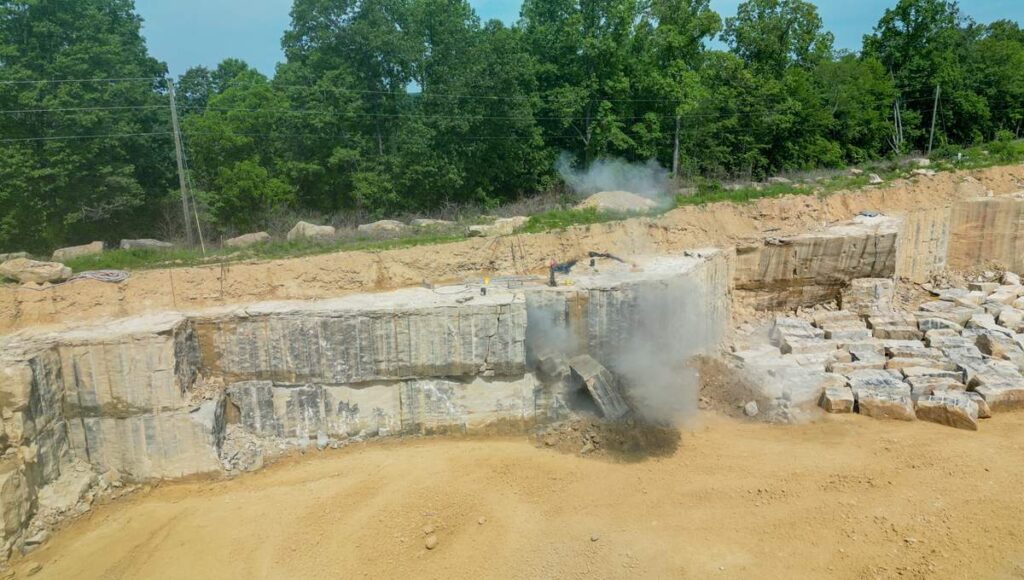
Because of the large stones and the explosives needed to harvest them, proper safety protocols are a must. Phil says they made their share of mistakes to begin with, but they were grateful for the patience the explosives inspector had with them. “There were a lot of things to learn, but he sat down with us and helped us sort it out,” Phil said.
In one incident, explosives were placed on a ledge of rock at the stone quarry. After the top half was blasted off, the holes were loaded for another blast, but the workers forgot to put away the additional explosives spool. When the set of charges detonated, debris hit the extra spool, creating a massive fireball. Due to their extensive training, the workers were a safe distance away, but the blast created a major jolt that shook some screens out of the office windows. The reverberation of that learning experience still echoes today.
Ready for the Big Saw
Once the stones are in the shop, Alan Mast and his crew of five take over. Here we see another fascinating feature of the business—a saw blade measuring almost 12 feet in diameter. The mammoth saw blade is diamond-tipped and operates on a large beam through CNC programming. The saw cuts 6-inches deep per pass, taking approximately 20 minutes to cut a slab. An average-sized stone takes 2-3 hours to cut, depending on slab thickness. Barring any setbacks, a set of teeth for the saw blade lasts an entire month.
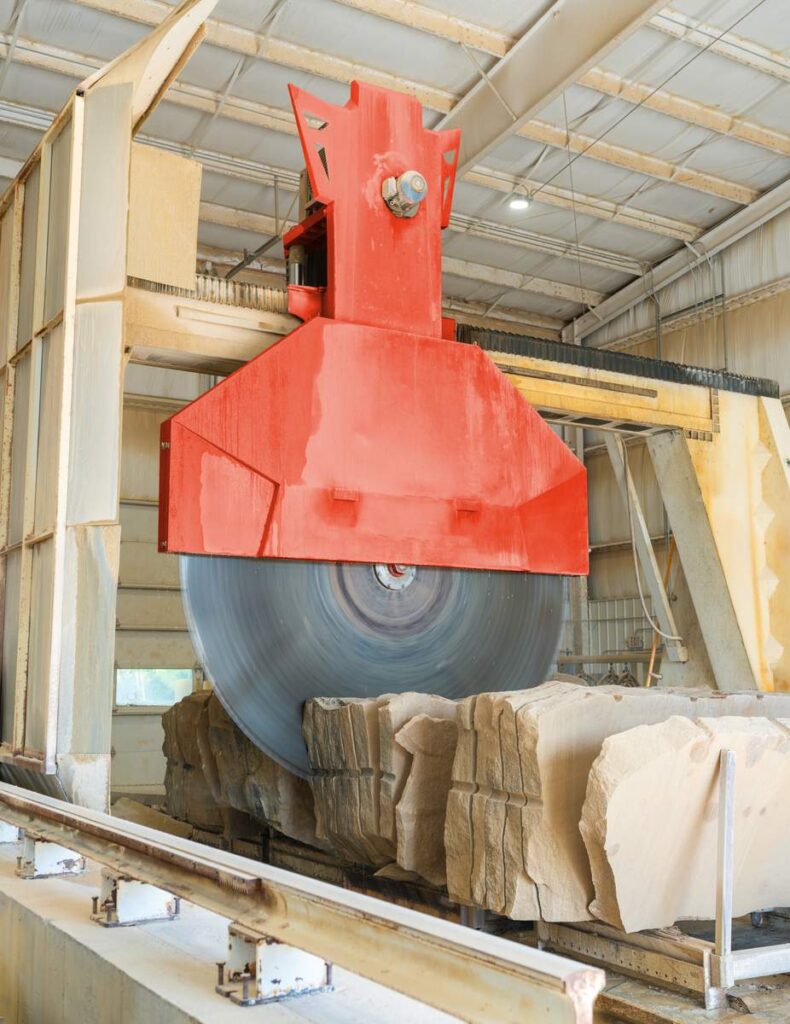
Up to five 12-ton rocks can be loaded onto the carts at a time. The large saw is programmed to cut them into slabs of the correct width. In addition to the daytime production, the saw continues to work after hours. The crew loads the saw prior to leaving for the day and returns in the morning to five carts of cut stone.
After being slabbed, the stones move into the other cutting area where a saw with a smaller blade measuring “only” 5 feet in diameter cuts the slabs to the correct dimensions to fulfill the current orders. These can be for retaining wall blocks, wall panels, headers, sills, caps, and lots of other options.
Alan says that the shop’s biggest challenge has been finding ways to maximize yield and minimize waste. While they want to fill orders, they also want to properly utilize their materials. With hidden crevices and voids in some stones, excessive waste can be a big problem. Currently, the waste is broken up and used as base material in the yard, but they are seeking new ways to use it.
Once the acquisition of the old mill was finalized, the assets were liquidated. The location currently serves as a bargain lot for a variety of sandstone products for walk-in customers. A popular seller is their landscaping stone with a barn stone texture. The neatly shaped stone is often used for outdoor stair treads, retaining walls, patios, and even raised beds. Other uses include stone veneer for outdoor kitchens, fireplaces, pillars, and building exteriors.

Sales and Marketing
While the quarry and shop teams remain busy harvesting and cutting stone, Steven Miller handles sales and marketing. Along with the rest of the team, Steven has been grateful for the organization’s rich history. Instead of having to create their own market from scratch, they are working to wake up an existing market that was going to sleep.
Since the old Briar Hill gradually lost the trust of some of their dealers, the new Briar Hill had to put in extra effort to regain that trust. One time, Steven made a trip to West Virginia to explain the transition to a dealer, and they slowly regained his trust and are supplying him with stone once again.
Steven says that what makes the company unique is their diversity of colors. They offer six different colors, with their cream/tan being the top seller. In the old days, Aquia Creek sandstone from the eastern states was often used in Washington D.C., including in the Arlington National Cemetery. Those quarries are no longer available, but Briar Hill’s current stone matches that stone as closely as anyone’s, which is why some customers source from Briar Hill. Currently, they are working on stone for a remodel project at Yale University.
This year alone, Briar Hill has sent seven truckloads of stone to Long Island through a market connection that dates back to the 1930s. Additionally, they’ve done work for the George Washington Memorial Homestead, other U.S. government facilities, and even the Federal Reserve Bank. All because of their rich history.
The Road Ahead
Overall, the company’s 100-year legacy continues to serve them well. They hope to pick up more architectural projects going forward and continue increasing efficiency and production.
The team is grateful to the group of employees who have stuck it out with them. Most weeks, Tobias spends an afternoon with the team, meeting to discuss and challenges the young leaders face. The work can be messy, but they’ve proven that good culture trumps many imperfections.
Through constant connections during coffee time, combined with safety, humor, and learning experiences, the team at Briar Hill is eager to see what lies ahead. Whether through relationships that date back over 100 years or the new ones they aspire to develop, their goal is to help others create beautiful, durable, and timeless projects that stand the test of time.
About the Business
Briar Hill Sandstone is in Coshocton County, Ohio, at 31879 Township Rd 330, Warsaw, OH 43844. They can be reached by phone at 330.377.5000, or by email at sales@briarhillsandstone.com.
About the Author
Marion Kuhns lives in Holmes County, Ohio, with his wife and children, dividing his time among work, freelance writing, and the occasional game of Candy Land. Local businesses in the greater Holmes County area interested in being featured in PCBE may contact Marion directly at 234.799.0008.