
“But this isn’t what I ordered.” The customer’s voice was insistent, even aggravated.
Nathan Yoder, clutching the phone to his ear, took a deep breath, then exhaled slowly. “Okay, I understand,” he said, his voice mild. “When you got home, what you had wasn’t what you wanted. I’ll tell you what: bring the product back in here, and I’ll make it right for you.”
Later that day, the man came into the store and set his wrong order on the counter. Nathan, owner of Maysville Elevator, quietly corrected it, then turned to the waiting man. “I think I have everything straightened out with your order. Now, I’d like to offer to pay for your trip expenses as well, since you had to come back in here to get it fixed.”
The customer blinked. Was he really being offered to have his gas paid as well?
What happens when a business owner goes the second mile for the customer, as in this case?
“He became a regular customer after that,” Nathan said. “He was just in here last Saturday.”
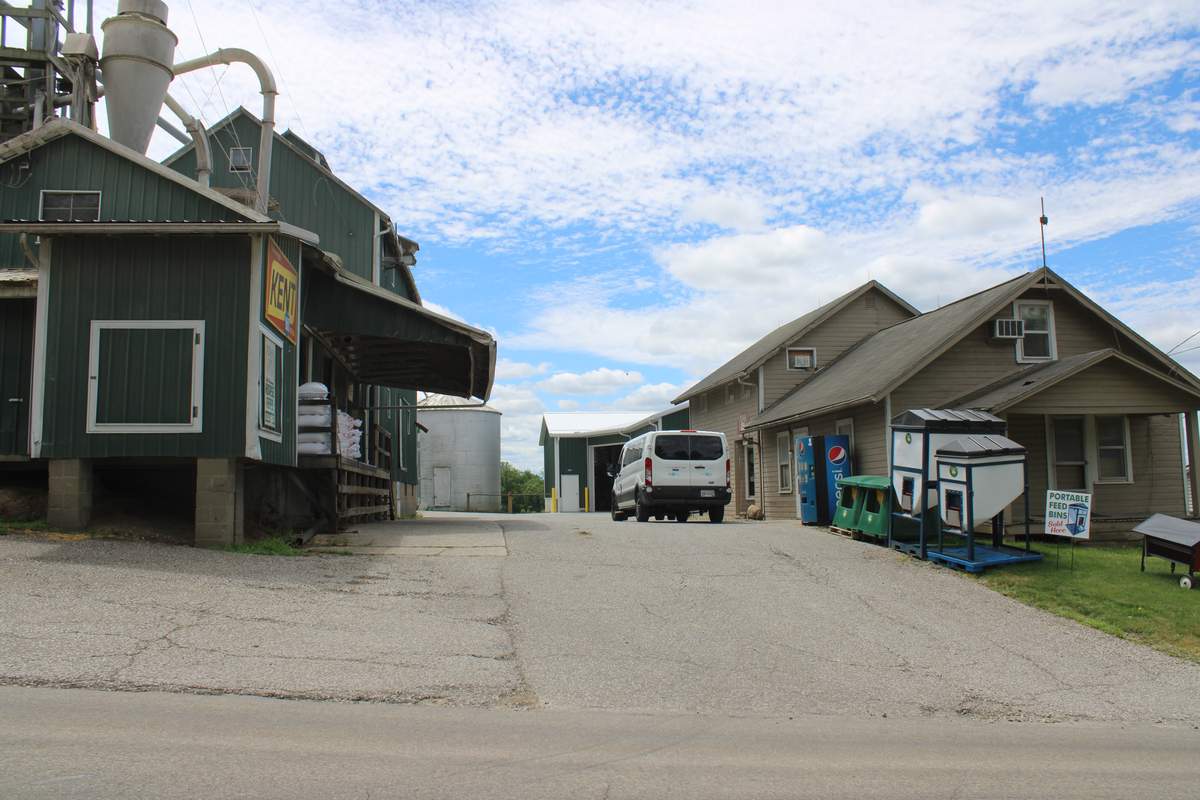
Maysville Elevator has been in business, supplying the local community with custom feeds, for nearly 75 years. In walking through the original (and still in use) elevator, you might notice the timber frame beams; hand-fitted, drawbored, and pegged with wooden pegs. In a world where everything is “Go big or go home,” the wisdom of a simple local business that has been serving the community for over seven decades is refreshing. It didn’t happen by accident. It is built on trust.
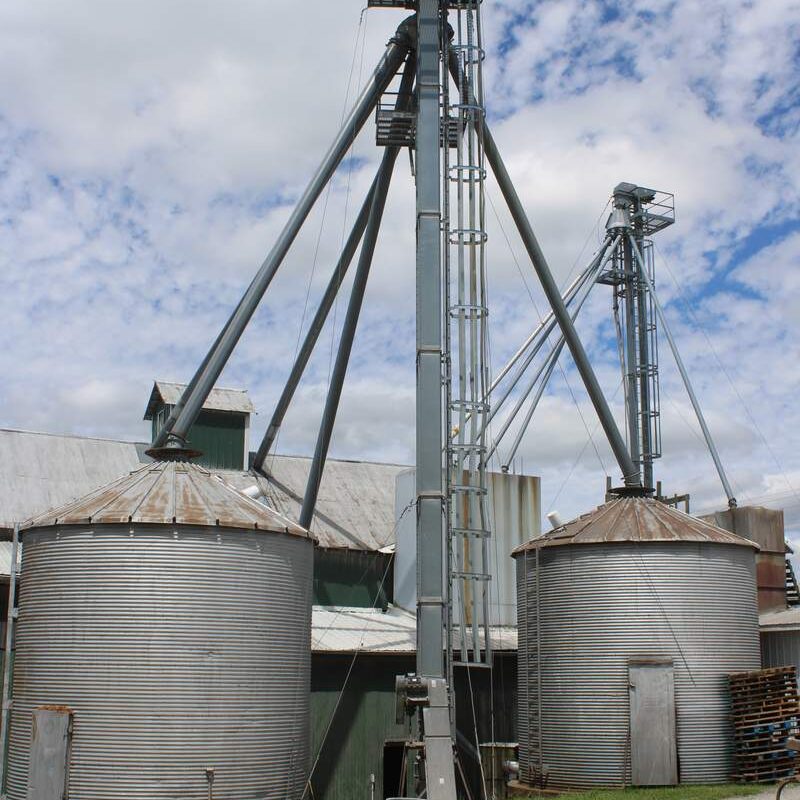
Located at 10583 Harrison Rd, Apple Creek, Ohio, just north of Holmes County, Maysville Elevator was founded in the 1950s and has been in continuous operation for close to ¾ of a century. Most of the custom mixes they grind are organic or non-GMO.
The above story is not an isolated incident.
In another case many years ago, a customer claimed Maysville Elevator’s feed was the reason a horse died. It was not proven, but Nathan quietly paid the man what he said his horse was worth. In still another case, a forklift driver, while loading a pickup, bumped the side of the truck, causing a bit of damage. Nathan told the owner, “Take the truck down to Autoworks in Holmesville and get an estimate.”
The truck was fixed, and Nathan paid the bill. After the bill was paid, Nathan made one more call. “I called him,” Nathan said, “and asked him, ‘Are you satisfied with the way they fixed it?’”
“Yes,” the customer said. “They did a good job.”
A feed mill is dependent on repeat customers, which is to say, it depends on its reputation in the local community. A local community that, in this case, appears to have reason to trust it based on the quality of care these stories illustrate.
But what about day-to-day operations? What does a typical day at Maysville Elevator look like?
The phone is ringing. It’s the owner of a small organic dairy farm. He’s been hearing about the advantages of using feeds custom-formulated to his own hay crop but is unsure of how to get started. He’s already mixing his feeds from his own corn silage and hay but has a feeling the yields and butterfat content would be higher if he had his mineral and vitamin levels where they belong. Can Maysville Elevator help?
Maysville dispatches Tim Yoder to the man’s farm, and he brings back a sample from the current hay and corn silage crop. The sample is prepped and sent to a lab in Wooster, and the results are emailed to Crystal Creek, the organic supplier Maysville Elevator uses.
When the results come back from Crystal Creek, they show that the mix the farmer has been using is too low in protein and, as the farmer suspected, is low in several vitamins and minerals, including calcium and a few micro-minerals. Crystal Creek has included their recommendation for a feed ration.
Adding organic soybean meal into the farmer’s mix, along with the correct amount of calcium and other missing vitamins and minerals, will enable him to hit all the macro- and micronutrient numbers he’s looking for. Maysville Elevator prepares the mix and delivers it to the farmer.
The farmer takes the soybean meal/mineral mix and, adding it to his own TMR1 mixer at the rate specified along with the correct amounts of his own corn silage and hay, now has a feed custom-built for his dairy using his own feedstock.
Like any health and nutrition-based method, it can take time to work. It can take a while for the higher butterfat and protein contents to show up in the milk. It can also take a while for the farmer to see that his herd’s reproduction rate is improving, during which time he is taking the elevator’s word that it really is a better mix. Once again, it comes down to trust.
“The benefits would usually be better milk production and healthier animals,” Nathan says. “Less disease. Better reproduction. More milk production. Better components. Higher butterfat and higher protein.
“It’s common for a farmer to stick with it once they start seeing the results. If we can keep them for six months to a year, we expect to keep them long term.
“You might lose them to competition sometimes, but you don’t generally see them going back to not using blended feeds. We have a decent customer base that has been with us for years and years.”
It’s not just customers who have been with them for years. Their longest-term employee, Bert Swartzentruber, has been with the business for 52 years. What prompts a man to stay with the same small company for over half a century?
“It’s close to home, and I like it,” he says. “The days go fast. Also, if I give a bit of notice, I can get off work. I just took off last week for three days for a family reunion.” He points out that some things have changed. “The standard feed sacks used to be a hundred pounds. Then they went down to eighty pounds and now to fifty. That makes life easier,” he says, smiling.
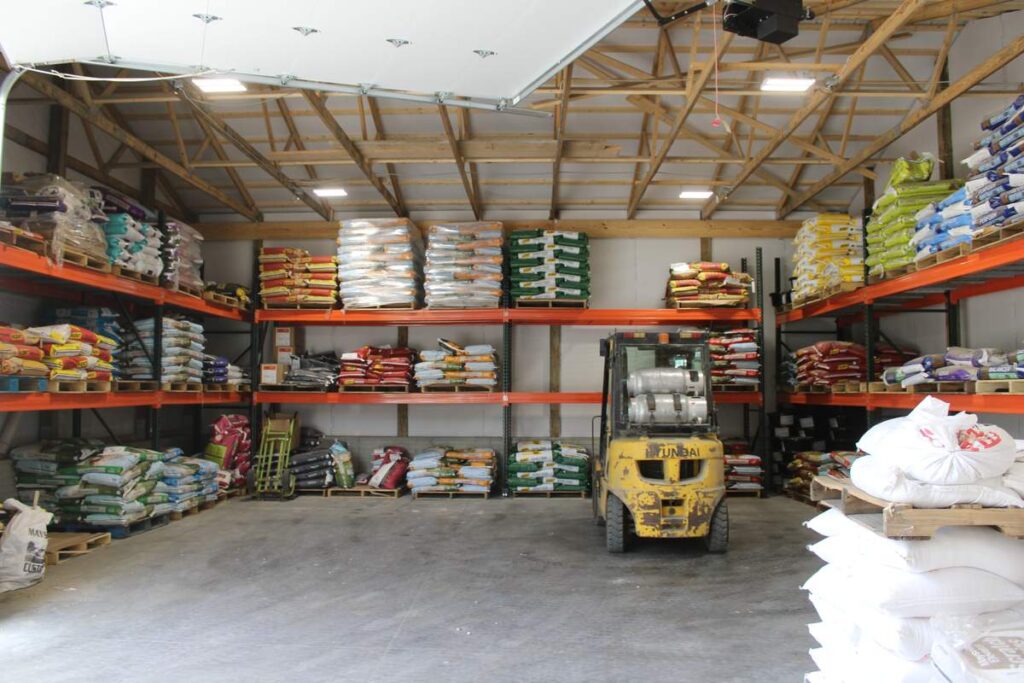
It’s not just dairies that benefit from Maysville’s presence. Much custom feed goes to goat and sheep herds in the nearby Swartzentruber Amish community. Custom poultry blends are mixed, ground, and shipped as well. Much is shipped to local customers on the elevator’s free Tuesday delivery route, but Maysville Elevator also ships to out-of-state customers via truck freight.
Maysville creates standard feeds as well, but mostly organic or non-GMO by customer request.
A typical non-GMO feed order will get called in. Jonathan, sitting in the office, takes the call. Carefully noting the desired protein and fat content, he calculates a formula for a layer mash. The final recipe is printed, added to a clipboard, and sent to the mill. A young man grabs the clipboard and looks over the numbers.
“Let’s see, it’s 1,100 lbs. of corn, 500 lbs. of soybean meal, 250 lbs. of feeding lime, and 50 pounds of our standard poultry vitamin and mineral blend.”
Grabbing a “weigh buggy,” a wheeled cart with a deep bin and onboard scale, he walks down the elevator’s aisle and pushes the buggy under the bottom of the corn bin’s exit chute. He reaches up and pulls back a board, releasing a stream of golden non-GMO corn into the hopper while keeping a close eye on the built-in scale. When the correct corn poundage is in the hopper, he shoots the board shut. Next, he wheels over to the soybean meal bin to add that item. When all the ingredients are in the weigh buggy, the young man pushes it over to the grate in the floor leading to the hammer mill. He opens the slot in the front of the weigh buggy and waits while the mix streams through the floor grate and into the mill below.
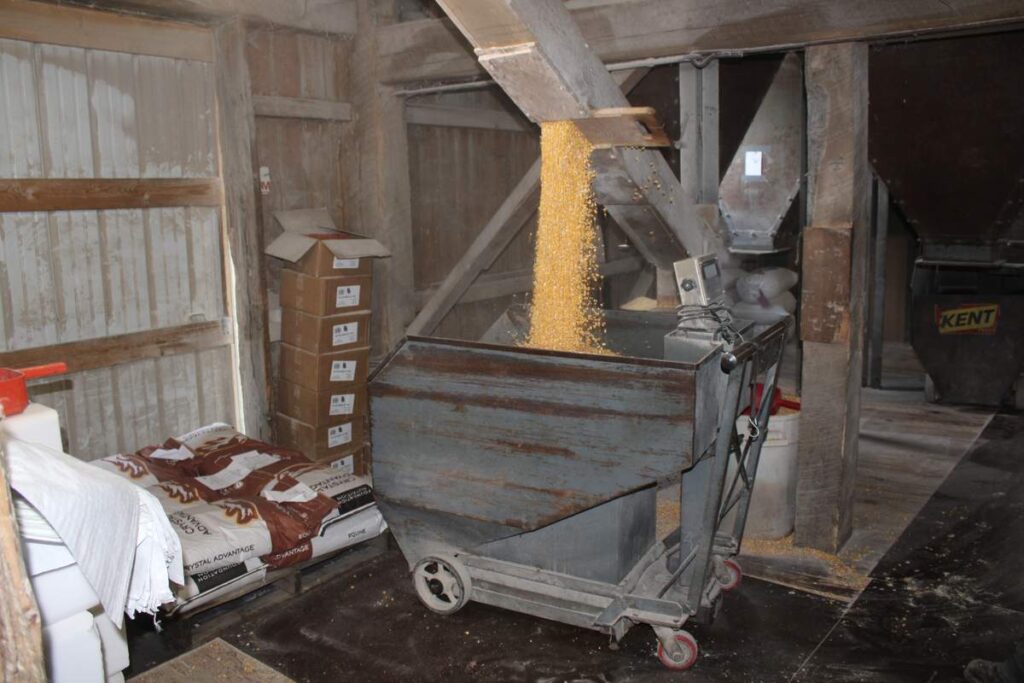
Following the hammer mill, it goes into the drum mixer, is thoroughly mixed, then bagged and placed on the freight dock outside with the customer’s information attached to the bag. Just another custom non-GMO poultry order ready to be picked up, like so many others the freight dock has seen over the decades.
The organic process is basically the same, but the organic grain is not stored on-site like the non-GMO product. It is safely warehoused down the road at a separate facility.
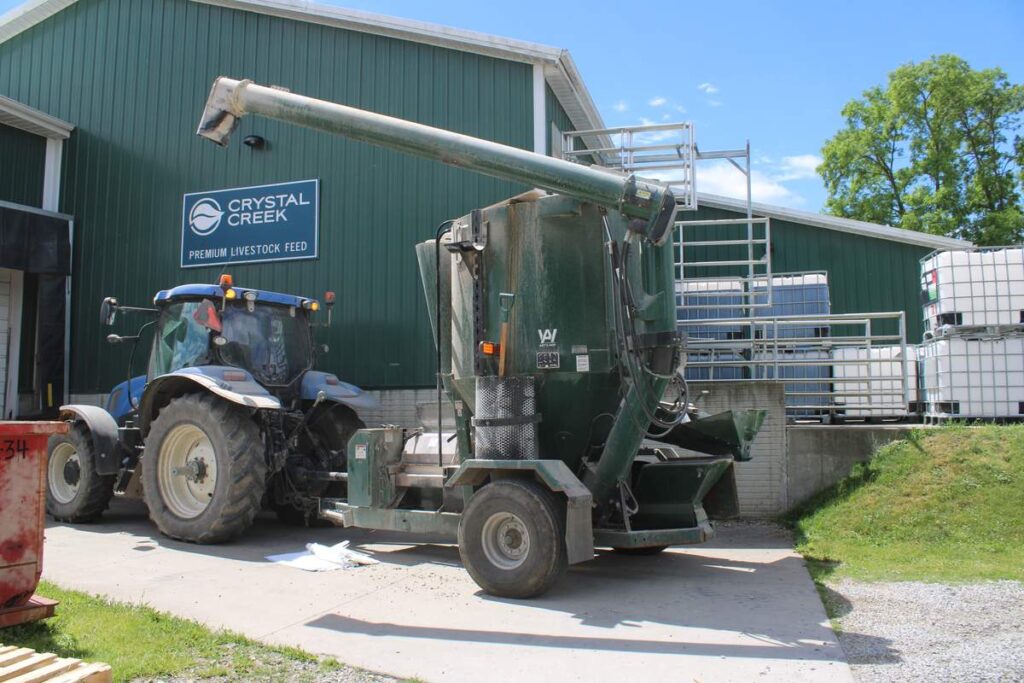
To fill an organic order, an employee will drive Maysville’s mixer tractor down the road, pulling their dedicated organic mixer/grinder. Pulling it from bin to bin, he’ll add the correct amounts of grain to the mobile grinder’s hopper, watching the built-in scale to ensure he hits the correct mix recipe. It’s the same process as the non-GMO feeds but on a larger scale. The finished organic mix can then be augered directly from the mixer/grinder into one-ton feed totes to be taken away by forklift, or right into the freshly cleaned and purged bulk truck if it’s for bulk delivery.
It’s not just animals that get custom mixes. Through Maysville Elevator, the soil does as well.
A local farmer is worried. He is standing in his field, puzzled. I don’t know why I can’t ever get a good stand of alfalfa in this field. My other fields do fine, but this one. . . He shakes his head. It just doesn’t produce. It barely comes up, and what does, looks sick. I should call Maysville Elevator. I know they have someone on staff that can test the soil. I wonder what they would say?
He calls the elevator. Jonathan Miller answers the phone, and the farmer explains his situation. After talking it over with Jonathan, he decides to have the soil tested. Two days later, Nelson Brenneman pulls up in Maysville Elevator’s company truck, and he and Joel Kurtz step out and meet the farmer in the field. They look over the field as the farmer explains his frustration at not being able to get a crop from it. After listening for a few minutes and asking several questions, Nelson and Joel nod, then spread out over the field, taking soil samples from half a dozen locations.
The soil samples are carefully mixed and shipped to the lab. A few weeks later, the results are back.
The field is low in phosphorus. Of course, it will not grow alfalfa. It needs phosphorus to germinate, and low potassium levels are preventing a good stand of what does manage to germinate. The field’s low calcium and boron aren’t helping anything, either. After studying the results, Joel Kurtz sets to work to create a fertilizer blend for just that field.
“We start from scratch with each sample, then build the custom blend from there,” Nathan says.
The custom formulation is shipped to the farmer and applied that fall.
This field should germinate much better next year, and, due to the custom-balanced soil formulation, that now-germinated seed should be good to grow. Joel has already formulated a three-year plan for just this field. At the end of three years, they’ll test again and readjust if necessary.
Back at Maysville Elevator, the phone is ringing again. Another piece of ground needs help. This time, it is a tiny garden plot behind a townhouse. It just will not grow good tomatoes. The lady explains that some of the other vegetables aren’t doing well, either.
Joel steps into action. A soil sample is taken, and the results are studied. A custom formulation for the tiny garden is blended. But wait; that will not save this year’s crop. This lady needs help now. Joel recommends an organic foliar feed called Power Flower. This organic liquid, mixed with water and applied with a hand sprayer, should provide this garden with what it needs now. With the mixture applied once or twice a week, the crop can still be saved. The canning room will be full this year. By taking the sample in July as they did, they can have the custom fertilizer mix ready to blend in this fall. After the crop is off, the custom-formulated fertilizer granules can be spread with a hand spreader and lightly tilled in. Until then, the foliar feed should save the day.
At the elevator, the phone rings again. A calf on an organic dairy is sick. Does Maysville Elevator have any organic health treatments that might help?
“As a matter of fact, we do,” Jonathan says, stepping over to their organic supplement display. “What did you say those symptoms were again?” And another day in Maysville Elevator goes on, providing trustworthy, personalized care for the community as it has for three-quarters of a century.
The little elevator in Maysville, Ohio, that has been serving its customers longer than most people have been alive is still here, providing personalized service, products, and expertise. It is still taking care of its community like businesses used to. . . and some, at least, still do.
About the Business
Maysville Elevator mixes custom feed and soil blends with small-town care and big results. Visit 10583 Harrison Rd, Apple Creek, OH 44606 or call 330.695.4413.
About the Author
Darryl Derstine lives in Holmes County, Ohio, with his loyal wife, Jessica, and is the father of four girls and four boys. He works for Christian Aid Ministries and does freelance writing.
Footnotes
1Total mix ration